Sam Knapp at Offbeet Farm Does More than Grow Food— He Stores it Most of the Winter and Writes About it

Sam Knapp could do anything. He has degrees in physics and chemistry as well as an advanced degree in plant ecology. Yet, here he is in Fairbanks, Alaska, making a living growing a wide variety of crops that he stores and sells only in the winter. Oh, and writing about it. I asked him why.

sam knapp with worker in field harvesting beets with storage facility in background
Sam Knapp harvests beets at Offbeet farm. Photo by Phil Knapp.

Post-college, Sam worked as an engineer in an office and volunteered on a farm on the weekends. He found the weekend work a lot more rewarding than the office work. Climate change mitigation and food security motivate him as well. Although reality has set in and his view of farming is less idyllic, he still finds the work satisfying, worthwhile and well aligned with his values.

Continue reading
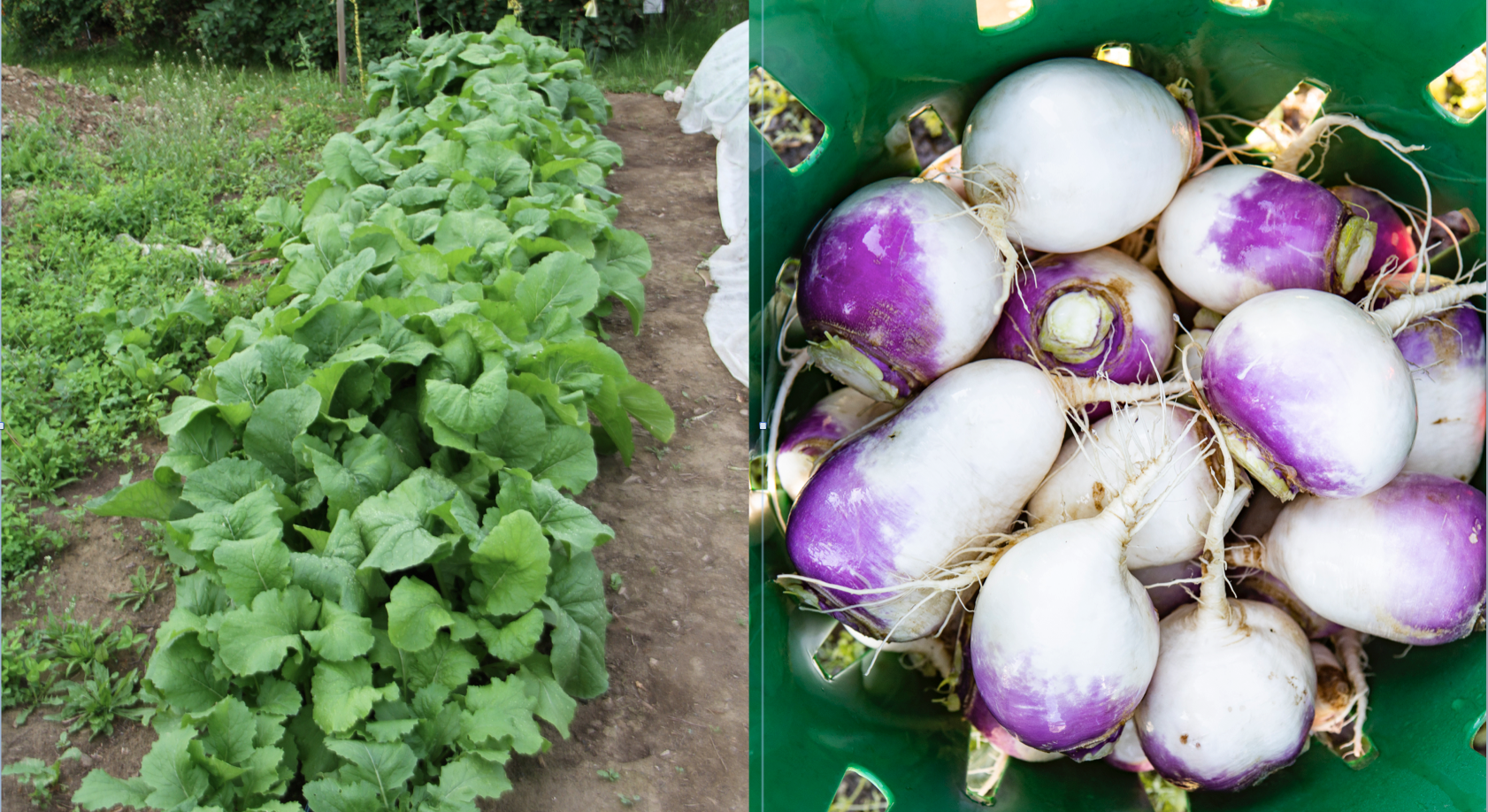
Growing Turnips, Radishes, and Rutabagas in Alaska

The Brassicaceae family includes a bunch of vegetables that grow super well in Alaska’s often cool weather. Some examples are broccoli, cauliflower, cabbage, turnips, daikon radishes, radishes and rutabagas. I’m going to talk about a few of the below-ground or root brassica vegetables now.

You can eat turnips and their greens. Left, photo by Glenna Gannon; right, photo by J.R. Ancheta.

When you think of a radish, you probably think of a small, round, radish (red on the outside and white on the inside) commonly sold in grocery stores. These mature super quickly — in under three weeks. Examples of this type of radish are Cherriette or Cherry Belle. But radishes come in many shapes, sizes and colors. Some are long and cylindrical while some are short and stubby. Some are purple and some are white. Daikon radishes are the biggest radishes. They are white and spicy and make a good addition to kimchi or Korean sauerkraut. Here is a nice comparison chart of specialty radishes. At the Fairbanks Experiment Farm, we trialed just a few Daikon radishes in 2017 and found that Alpine and Summer Cross No. 3 grew big and long respectively. Continue reading